WOOP-SURPASS — A core platform team for ARPA-H SURPASS
Turning the wait before
treatment into evidence.
A Multi-Sponsor Adaptive Oncology Trial Platform
Each patient’s response to a brief perturbation, read in weeks, guides the trial.
Starting in early-stage breast cancer (pancreatic cancer under discussion), WOOP-SURPASS connects human biological evidence, adaptive trial design, and multisite operations.
Proposers' Day, 6 November 2026 · Status as of 5 November 2026
Register interest
 ElixirTrials
Led by the University of Illinois Cancer Center. Operations by ElixirTrials.
What changes
More robust, faster, adaptive.
For every cancer that starts with a biopsy and ends in a resection, there is a window of opportunity. A biomarker observed once predicts poorly. A change measured in the same patient after a brief, randomized perturbation, with the study drug or a third agent given alone, is a causal readout, available in weeks, inside a wait that exists anyway. WOOP-SURPASS makes that readout standard for every arm of a multi-sponsor platform, lets each patient’s own delta guide that patient’s next step, and learns which deltas predict benefit.
The same wait, shown twice: once as it is, once with the window inside it.
Today
- diagnosis · biopsy: biomarkers observed once
- work-up continues
- standard therapy starts, median 45 days
On the platform
The nested window · brief perturbation with the study drug or a third agent, randomized against no drug
The usual work-up continues · treatment start capped by protocol; the DSMB monitors delay
- Day 0 · biopsy + blood
- Post-window sample · tissue + blood, surgery or repeat biopsy; timing per agent
- By the cap · standard therapy starts (today’s median wait: 45 days)
| Today | On the platform | |
|---|---|---|
| More robust | Biomarkers observed once, before treatment. | The change in the same patient after a brief perturbation, randomized against no drug: a patient-specific biomarker delta. |
| Faster | The first signal in early-stage patients usually comes at surgery, after full neoadjuvant therapy. | A rapid biomarker delta inside the usual wait, read at a time set per agent and mechanism. |
| Adaptive | Window trials: usually one drug, one site, one protocol. | One master protocol: arms enter, adapt or stop, and the window itself can adapt as the platform learns. |
| Patient-specific | Trial decisions come from arm averages. | Each patient’s own delta can inform that patient’s next step. |
Every arm adds paired perturbation and outcome data, so the platform is built to learn which early changes predict benefit.
What we bring: first-hand window experience (BRE-04) and Cancer Center assays in use.
The master protocol
One master protocol, from first-in-patient safety to preliminary efficacy.
Before the window
First-in-human
Dose finding in metastatic disease at academic hubs.
Sets the dose and safety record needed to enter the window.
Nested study endpoint
Biomarker delta: the patient-specific change between paired samples. Endpoint and timing set per agent and mechanism; prespecified futility rules can stop an arm.
Arm decisions use monthly analyses pooled across patients; standard treatment is not altered.
Assignment and adaptation, to explore
Direct assignment to an arm, or weighted randomization among arms, under prespecified rules. Platform outcomes: PFS, OS or other.
What is new: a standing rule, not a one-off study. Every drug entering the platform gets the same first step, a brief, randomized perturbation with paired measurements inside the usual work-up, before any combination therapy, within one master protocol.
Three things are kept apart: the nested study’s biomarker endpoints, the prespecified rules for assignment and adaptation, and the platform’s clinical outcomes. The outcomes could include progression-free survival, overall survival or other appropriate measures, set by the final design and statistical plan. Where surgery follows neoadjuvant therapy, pathologic complete response and residual cancer burden can be measured; pCR can support accelerated approval in high-risk early breast cancer (FDA guidance, 2020) but is not a validated trial-level surrogate for survival.
Why the wait
45 days
Median from diagnosis to first-course treatment (surgery or neoadjuvant therapy). NCDB, nonmetastatic stage I–III breast cancer, patients who went on to surgery, 2022–23; 34 days in 2012–15.
Associated with longer waits: lowest area-level income, and treatment at academic centers.
Sakowitz et al., JAMA Surg 2026;161(10):1002–1011 (PMID 42584916).
Timing in practice
- Day 0Diagnosis sample and blood; randomize to drug or control.
- The windowDrug alone, or nothing, while the usual work-up continues; its length is set per agent and mechanism.
- Paired sampleTissue and blood again, in both arms, on the same schedule. For most patients definitive surgery provides the tissue; patients who need a full chemotherapy course may need a separate biopsy near the investigational treatment.
- ≤ 7 and ≤ 21 daysBlood and tissue results back; into the next monthly analysis. Design targets, not yet measured.
- By the capStandard therapy starts; the DSMB monitors delay.
What the window measures
Designed to fit inside the usual work-up without delaying standard treatment: every arm carries a protocol cap on time to standard therapy, and the DSMB monitors delay from the first patient. Whether the platform adds no delay is measured, not assumed.
- Paired samples. Biopsy and blood at diagnosis, then tissue and blood again at a time set per agent and mechanism, in both the drug and the control arm, on the same schedule. For most patients definitive surgery provides the second tissue sample; a full chemotherapy course may call for a separate biopsy near the investigational treatment. In BRE-04 the second tissue was taken as soon as possible more than one day after the final investigational dose; that is BRE-04’s schedule, not the platform’s.
- Target engagement, matched to the mechanism. Proliferation markers for anti-proliferative or endocrine agents; immune and spatial markers for immune or epigenetic priming; ctDNA kinetics as a supporting signal. Only Ki67 after short-course endocrine therapy has prospective outcome data as a window marker; it is prognostic, not a validated surrogate. Markers for immune or epigenetic agents are exploratory until the platform validates them. A candidate general endpoint is the change in T-cell proximity to cancer cells, the measure BRE-04 reported; it is a candidate, not a selected or validated decision rule.
- Rules for assignment and adaptation. Two approaches are on the table. Perturb with the drug under test and let the delta inform whether the patient proceeds to that arm (direct assignment); or perturb with the study drug or a third agent and let the delta weight a randomized assignment among arms or strategies, alongside the platform’s own adaptation. Both are approaches to explore with biostatistics partners; no threshold or weight is set, and biomarker-guided selection is not yet validated. Prespecified futility rules can stop an arm; the window never advances a drug on its own.
- Why randomized. A before-and-after comparison in one arm does not separate the drug's effect from time, sampling and surgery; a concurrent control does. BRE-04 showed a signal; the platform is built to test it.
Human evidence
BRE-04: human proof of concept for immune remodeling.
A separate single-site trial at the University of Illinois Cancer Center: groundwork that informs the approach, not the window nested in the platform, and its endpoints do not carry over.
completed treatment before surgery (AACR 2026 abstract)
paired pre/post specimens; the nine in the AACR 2026 analysis
No serious adverse events reported among the 27 treated patients (AACR 2026 abstract); an observation, not a safety conclusion.
Single-arm, single-site trial (ClinicalTrials.gov NCT04891068, recruiting; last updated 23 Jun 2026). Five days of a low-dose hypomethylating agent given subcutaneously after diagnosis, with tumor and blood sampled before and after (the post-treatment tissue as soon as possible more than one day after the final dose), then standard surgery. Eligible: triple-negative, or ER-positive with high-risk features; the registry also lists HER2-positive disease. Planned enrollment 40. Pre-treatment specimens were diagnostic core biopsies; post-treatment specimens were surgical resections. Because the specimen type differs, sampling can contribute to the change. 22 patients have documented paired pre-treatment biopsies and post-treatment surgical specimens. The nine analyzed for AACR 2026 were the first nine with paired specimens available for multiplex immunofluorescence. Additional analyses are pending. Registered primary endpoint: change in tumor-infiltrating lymphocyte (TIL) count at 2 weeks from the first dose. The team measures TILs by multiplex immunofluorescence (T-cell density and spatial distribution). The distance result below is exploratory and is not the registered primary endpoint. CD8+ (p = 0.82) and CD4+ (p > 0.99) T-cell densities, in cells/mm² of all tissue, were not significantly changed, in either direction. The primary analysis is not yet reported, and no results are posted on the registry.
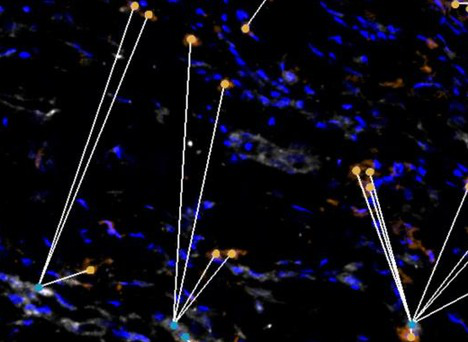
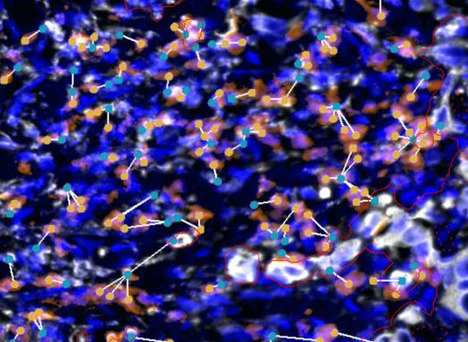
Post-treatment tumors showed a 45.3 % reduction in the average distance between CD8+ T cells and PanCK+ tumor cells: group means 29.84 to 16.31 µm, shorter in 8 of 9 patients, two-sided Wilcoxon matched-pairs signed-rank test, p = 0.0195. Medians 21.70 to 15.87 µm. One patient (BRE-04-002, 91.1 to 11.2 µm) contributes 66 % of the summed paired differences. Sensitivity analysis (exploratory, not a replacement for the main analysis): excluding that patient, the change of means is −23.6 % (22.19 to 16.95 µm), 7 of 8 shorter, exact two-sided Wilcoxon p = 0.039. The abstract also reports directional, untested increases in effector subsets and no expansion of regulatory T cells. The AACR poster also reported peripheral immune profiling and cytokine analyses (not shown here).
The measured population is CD8+ T cells to PanCK+ tumor cells (the abstract says “immune cells”).
Read with care
Single arm, exploratory, one of many markers tested, without correction for multiple comparisons. Pre = diagnostic core biopsy, post = surgical resection; sampling alone can change the distance. Nine of 22 paired specimens analyzed; additional analyses pending. The result shows where CD8+ T cells sit, not clinical benefit or safety. BRE-04 is powered for short-term translational tissue endpoints; long-term efficacy is exploratory at best. Final results pending. Godoy-Calderón et al., Cancer Res 2026;86(8 Suppl):CT263.
Distance from CD8+ T cells to the nearest PanCK+ tumor cell
Multiplex immunofluorescence panel: CD8, CD4, CD45RO, FoxP3, PD-1, PanCK, plus DAPI.
Cancer Center assays in use · Open to AI pathology partners
Biology The biological evidence layer.
Paired tissue and blood samples, before and after the perturbation, profiled into each patient’s biomarker delta.
Paired tissue and blood samples
Before and after the perturbation
Multimodal biological profiling
Spatial immunophenotyping · Spectral flow · Cytokines · Agent-specific biomarkers
Quantified biological evidence
Target engagement · Immune remodeling · Pharmacodynamic response
Evidence-informed adaptive decisions
Prespecified rules for arm continuation, adaptation or discontinuation. Window endpoints: short-term translational and pharmacodynamic changes. Randomized trial endpoints: PFS, OS or other clinical outcomes.
TA1 simulation · TA2 inference · TA3 operations
Cancer Center lab: multiplex spatial imaging, spectral flow, cytokines, ctDNA; AI pathology for consistent reads across sites. Harmonized measurement at every site: community sites collect; the Cancer Center lab measures, with shared panels and thresholds; reproducibility across sites will be measured.
- Multiplex spatial imagingIn useWhere T cells and other immune subsets sit relative to tumor cells.
- Spectral flow cytometryIn useImmune cell states in blood and tissue.
- CytokinesIn useSystemic immune signals.
- ctDNAIn useTumor burden kinetics, a supporting signal.
- AI spatial pathologyPartner soughtConsistent, scalable reads across sites.
Status per the University of Illinois Cancer Center.
Technical areas
Three technical areas, one platform.
TA1 · Simulation.
ARPA-H asks (ISO §2.2.3): a simulation-based design engine that represents the whole seamless design, including shared controls; lets heterogeneous models work together through APIs; estimates operating characteristics per arm and for the platform; and evaluates models on held-out data, then prospectively on platform data.
In the platform: the design engine that sizes arms, sets the futility rules and tests designs before use.
Status: open to partners. Simulation and modeling partners bring predictive modeling expertise and gain a role testing new designs (in discussion).
Register this interestTA2 · Inference.
ARPA-H asks (ISO §2.2.4): a continuous-inference engine with seamless transitions from safety to efficacy; arms added and removed; prespecified futility, efficacy and safety rules; response-adaptive randomization; controls augmented with in silico information; and interim analyses monthly or more often.
In the platform: the prespecified rules that turn each patient’s biomarker delta and the platform’s outcomes into assignment, continuation, adaptation or discontinuation decisions; direct assignment and weighted randomization are the two approaches to explore.
Status: open to partners. Biostatistics partners bring adaptive-trial expertise and gain a role shaping statistical decisions (in discussion).
Register this interestTA3 · Operations.
ARPA-H asks (ISO §2.2.5): the operations work sites otherwise do by hand: participant pre-screening; patient identification, recruitment, enrollment and retention; clinical data collection; site activation and management. ARPA-H’s per-arm targets: contracts under 1 month, then under 1 week; IRB approval within 3 weeks, then under 1 week; FDA “may proceed” to first dose under 3 months, then under 1 month.
In the platform: ElixirTrials runs EHR-integrated pre-screening, consent and scheduling under one master protocol.
Status: pre-screening goes live on real EHR data in November 2026; the consent-gated screening visit is in development; no patients enrolled yet.
Register this interestOpen to partners
TA1 Design engine
Planned: simulates every arm before and during the trial. Prognostic and control models are trained on standard-care EHR data and validated before use. Any reduction of randomized controls follows validation and regulatory input.
Open to methods partners
TA2 Continuous inference
Planned monthly Bayesian analyses with error control, run by an independent statistical analysis committee (SAC); models change only at locked releases.
Going live Nov 2026
TA3 Agentic operations
Prescreening, site start-up, data capture and cleaning now; the consent-gated screening visit and specimen tracking are in development; the audit chain, a tamper-evident record of every step, is built. Built so that a qualified hospital can run the platform's arms with its own staff, once training, laboratory logistics and oversight are in place.
Before consent, patient-level EHR data used for pre-screening stay inside the hospital's own account. What leaves the account for pre-screening: aggregate counts, model updates, and a pseudonymized log of actions (no clinical content). After consent, trial data go to the platform trial database as the protocol and consent describe.
Going live on real EHR data at a Chicago safety-net system, November 2026; no patients enrolled yet.
How a hospital becomes a site
- Built · Pilot Nov 20261 · Activate the hospital. A sealed cloud account from reviewed code; nothing installed on site; the EHR is read only.
- Built2 · Read the protocol. Protocol pages become structured criteria; a coordinator approves each one.
- Structured data built · Notes next3 · Pre-screen charts. Code checks structured data against approved criteria; AI note reading only orders the review queue.
- In development4 · Screening visit. Consent first; chart findings are previews; the investigator finalizes.
- Audit chain built · Specimen tracking in development5 · Run the trial. Each entry is sealed with the fingerprint of the one before; tamper evidence shows the record was not altered, and source-data accuracy is verified separately.
- Next6 · The next hospital. Same code, new account; approved criteria and learned mappings carry over.
ARPA-H TA3 metrics
| Program metric (ARPA-H-SOL-26-164 §2.2.5) | Interim target | Final target |
|---|---|---|
| IND submission to first subject dosed, for the platform | < 6 months | < 3 months |
| FDA “may proceed” to first dose, for each new arm | < 3 months | < 1 month |
| Contract execution for each new arm | < 1 month | < 1 week |
| IRB approval for each new arm | ≤ 3 weeks | < 1 week |
| Actual vs predicted enrollment rate, averaged across arms | within ±50% | within ±25% |
| Data collection time | ≤ 1 week | ≤ 2 days |
| Data cleaning and dataset construction time | ≤ 3 weeks | ≤ 1 week |
| Human hours consumed | ≤ ½ of historical FTE hours | ≤ ¼ of historical FTE hours (historical single-trial records) |
| Sponsor cost per arm vs three CRO quotes for an equivalent standalone trial of the same size | same as the lowest | below the lowest |
Targets as written in ARPA-H-SOL-26-164 §2.2.5. Mechanisms are design intent, to be measured. Comparators for human hours and cost are defined in the solicitation.
Mechanisms in Cauldron (design intent)
Templated master protocol and arm appendices. Master agreements per site, with arms as amendments. Central IRB. Enrollment forecasts from live EHR pre-screen counts. Data captured at the point of work, with checks run as data lands. Agents do the back office, and a named person approves each action. Shared platform overhead.
How this answers SURPASS
Innovation, feasibility, scalability.
Innovation
A patient’s own response to a brief perturbation, read in weeks, guides assignment and adaptation across a multi-sponsor platform.
Not the window itself: a standing, randomized perturbation with the drug alone, as the target check for every arm, in one master protocol. It is a standing rule: every drug entering the platform gets the same randomized, drug-alone target check inside one master protocol, arm after arm.
Feasibility
BRE-04 provides human window-of-opportunity experience and established immune-profiling capabilities.
Designed around real patient flow at academic hubs and in community and safety-net hospitals. BRE-04 gives the team first-hand window experience (single site, interim, 9 patients analyzed). The operations software is going live on real EHR data at a Chicago safety-net system, November 2026. Enrollment forecasts are design targets, not yet measured, and no patients are enrolled yet.
Scalability
Proposed multi-sponsor, multisite infrastructure with simulation, adaptive inference, and coordinated operations.
Scientific and technical merit (ISO §4.7)
Randomized concurrent controls. A patient-specific biomarker delta from the nested window. Platform outcomes such as progression-free or overall survival, per the final statistical plan. An independent statistical analysis committee, and models validated before use. Each ISO operations metric is mapped to a mechanism labeled design intent.
Program requirements
- All three technical areas in one team.
- One disease area.
- At least three drug or biologic arms, at least one with no prior human data.
- First site open to enrollment by program year 2.
- FDA authorization to proceed for the master-protocol IND and one arm is the Stage I gate.
- Required roles named or marked open (see Team).
Timeline: Stage I · build runs from month 0 to the stage gate at month 24, with the first site active in months 6–12. Stage II · validate and deploy runs to month 60.
Built to be reused
After the program, the operations templates, models and network are designed to be copied to other cancers, chosen with sponsors; each new cancer needs its own clinical design. Pancreatic cancer is under discussion.
The asks
Every partner brings one thing; every partner gets evidence back.
Access to trials is uneven. Rural patients and patients far from the treating center are less likely to be documented as trial participants, and racial and ethnic minorities remain under-represented. Waits to treatment are longest at academic centers. This platform is built to bring trials to patients where they are treated.
Drug sponsors
You bring: An investigational oncology agent.
You gain: Early human evidence.
If the platform is funded and your arm is accepted, patients are randomized to a brief course of your drug alone, or to a shared no-drug control, inside the usual work-up; under the second approach the perturbing agent can be a third agent. Paired tissue and blood samples are profiled at the Cancer Center, and prespecified rules turn the biomarker delta into assignment and continuation decisions.
Register this interestClinical sites
You bring: Clinical expertise and patients.
You gain: A coordinated research network.
Academic, community and safety-net clinics are all welcome. If the platform is funded, sites receive per-patient research payments, and ElixirTrials runs the operations under one master protocol. Pre-screening goes live on real EHR data in November 2026; the consent-gated screening visit is in development. No patients are enrolled yet, and site roles are in discussion.
Register this interestSimulation & modeling partners (TA1)
You bring: Predictive modeling expertise.
You gain: A role testing new designs.
Bring trial-simulation, disease, response or digital-twin models. If the platform is funded, partners get paired before-and-after drug measurements and patient outcomes as they accrue, under a data-use agreement, and a prospective test of adopted models on platform data, which SURPASS requires. Named TA1 roles, testing new designs, are in discussion. No patients are enrolled yet.
Register this interestBiostatistics partners (TA2)
You bring: Adaptive-trial expertise.
You gain: A role shaping statistical decisions.
Bring adaptive-trial expertise in biostatistics. Named lead roles in the proposal are in discussion. Leads shape the master protocol, the statistical analysis plan and the FDA engagement from the start, including the pre-IND meeting. Statisticians with digital-twin or predictive-model experience are especially wanted. SURPASS also requires regulatory affairs and project management on every team; those roles are open too.
Register this interestRegister interest
Register your interest.
Join WOOP-SURPASS: help build the next generation of adaptive oncology trials.
Seeking investigational drug sponsors, clinical sites, simulation experts, and adaptive trial statisticians.
Sponsors, sites, modeling partners, methods and regulatory leads. A person on the team reads every entry; registering is not a commitment.
Tell us who you are and what you could bring.

University of Illinois Cancer Center
V.K. Gadi, MD, PhD
Deputy Director, University of Illinois Cancer Center
Breast medical oncologist · vkgadi@uic.edu
University of Illinois Chicago
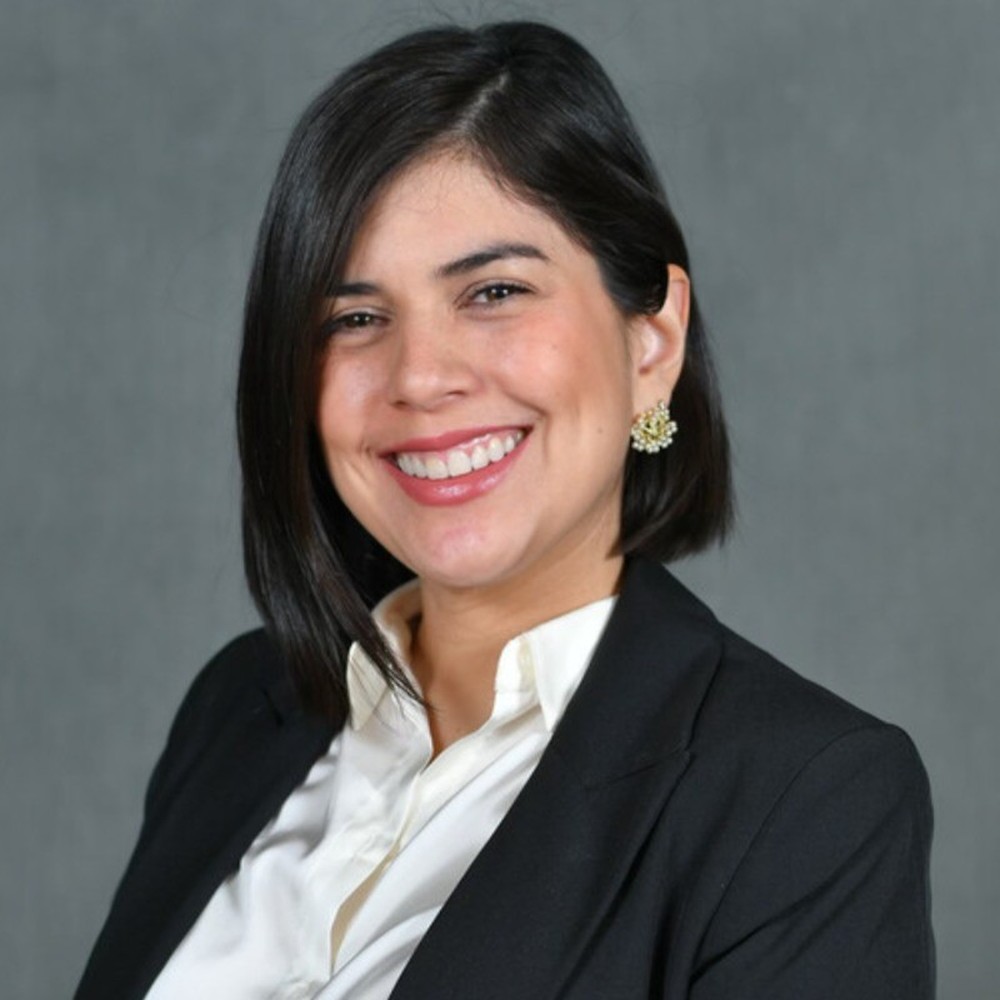
Maria José Godoy-Calderón, PhD
Research Assistant Professor, Department of Medicine


Proposed roles (in discussion)
University of Illinois Cancer Center
Lead platform operator; holds the master IND and the statistical analysis plan; chairs the steering committee; runs the evidence layer.
ElixirTrials
Technical Area 3, operations at every site.
Open roles
Trial-simulation partner (TA1); biostatistics lead for Bayesian platform design, with digital-twin or predictive-model experience (TA2); regulatory lead; project manager; at least two for-profit sponsors, including a small company with a first-in-human agent.
Materials
The lightning slide.
The one-slide summary submitted for the Proposers' Day lightning talk.
Materials
The composite poster.
A 44 × 44 inch poster of the platform: the nested window, the evidence layer, how the platform answers SURPASS, and what partners bring and gain.
Research portals
The research portals.
Three interactive research portals, one per indication of the platform: triple-negative breast cancer (the launch population), HR+/HER2− breast cancer (a later stratum) and pancreatic ductal adenocarcinoma (under discussion as the first copy outside breast cancer). Each has seven maps compiled from public sources with every fact linked: the active pipeline by approach and stage, the history of active and discontinued programs, a cell map of where each drug acts, and the ecosystem of investors, big pharma, foundations and researchers. The data behind every map is open (CSV, CC BY 4.0).